She Served: Building understanding for women veterans
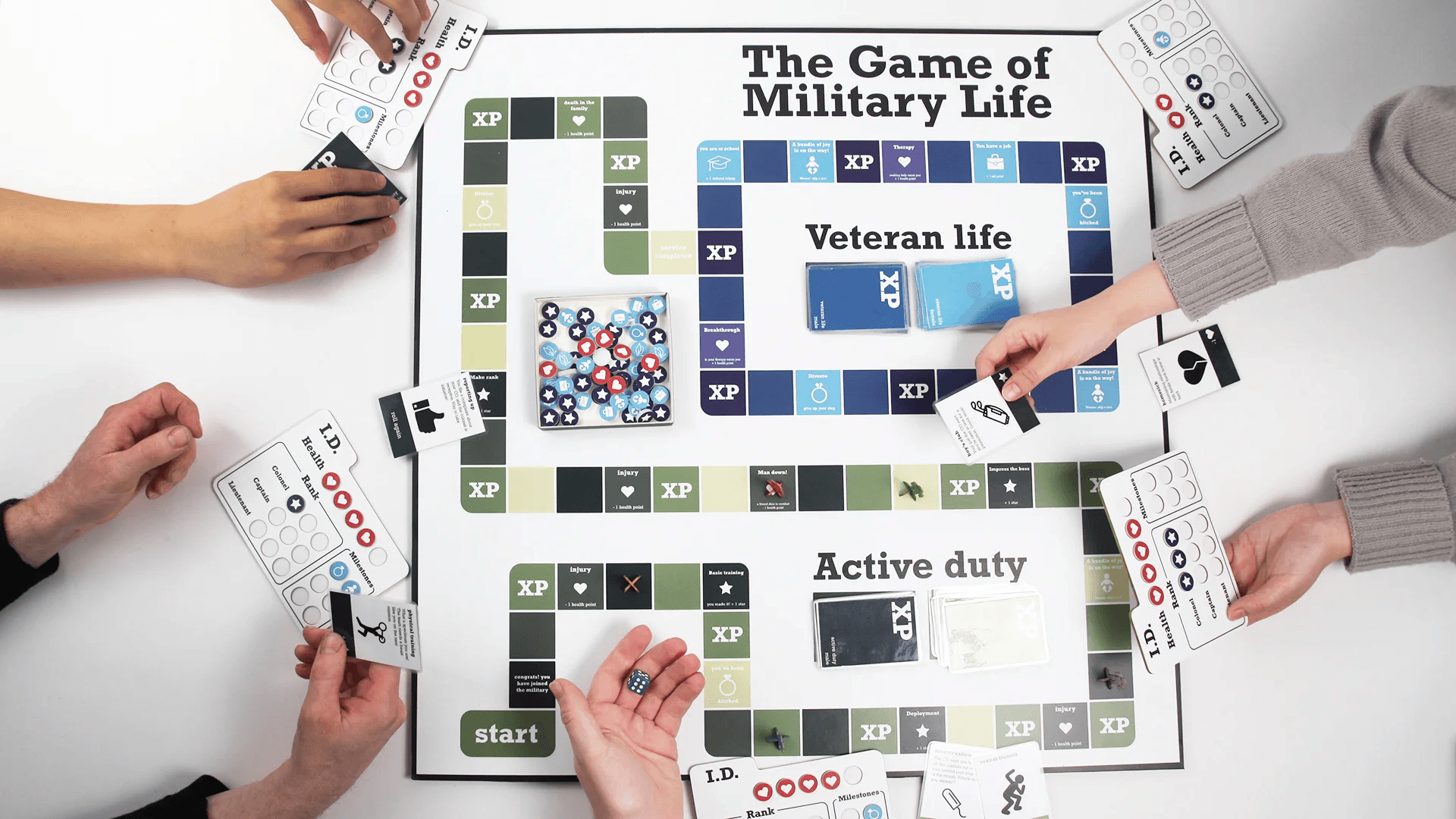
A boardgame and storytelling campaign designed to create empathy for women veterans in the US, She Served was the culmination of a 4-month user research project with the NY Veterans Affairs office.
This project was developed in 2017 with Alexia Cohen, Kevin Cook, Jiani Lin, Antriksh Nangia, and Teng Yu as part of the Design Research and Integration course led by Lawrence Abrahamson and in partnership with the New York Veterans Affairs Office.
- user research
- service design
- experiential design
- visual design
- Core77 Student Runner Up — Strategy & Research / 2017
- Core77 Student Notable — Design for Social Impact / 2017
- The Race — Denver 7 News
- Vantage Point — Official Blog of the U.S. Department of Veterans Affairs
The She Served Project was a 15-week user research and concept development project aimed at increasing visibility and understanding of US women military veterans, culminating in a proposed campaign and storytelling initiative. Read on to see what we learned, tested, and developed during the course of our research and development.
Women veterans are veterans too.
We spent fifteen weeks researching public perceptions of women veterans — and designing to change them. Here’s what we learned:
Women veterans are far less likely to outwardly project their veteran identity than their male counterparts.
Women vets feel that the media is more likely to portray them as victims than as heroes.
Both during and after active duty, military women tend to feel like the deck is stacked against them. We made a board game to show all the obstacles and excuses that make succeeding in the military — and just maintaining physical and mental health — such a challenge for women.
Process
Prompted by the question “How might we establish a new cultural norm that a woman veteran is also a veteran?”, we read everything we could about the woman veteran’s experience — and then we started interviewing. In two weeks, we conducted 10 expert interviews with women veterans and VA staff, 27 intercept interviews of civilians, and topped things off with an online survey.
We distilled a sea of quotes into insights and verified them with stakeholders using the tangible insights seen above. We refined our thinking into a final array of design principles — in the form of more pointed “how might we” questions — that we used to kick-start the ideation process.
Proposal
The #SheServed initiative is aimed at building public perception of women as an equal and significant part of the veteran community in the United States. By combining a platform for celebrating women servicemembers’ achievements with an accessible, shareable brand identity, this experiential campaign can empower women veterans and deliver their stories to a larger audience.
Wearable campaign
Inspired by the Livestrong campaign’s success in creating momentum around cancer research in the mid-2000s, the #SheServed campaign uses stark iconography and an eye-catching palette to increase recognition of the issues female veterans face. To wear the #SheServed insignia is to support the following statement:
The service and sacrifices of women veterans are equally significant to those of their male counterparts. I stand with veterans — women vets included — in their search for recognition and fair treatment.
Targeted to resonate with veterans, their families and the public at large, the campaign’s messaging encourages viewers to show support by wearing pins, hats and other #SheServed-branded collateral.
By driving participants to share hashtagged images of their #SheServed gear on social media, the campaign may grow its footprint at an exponential rate. And the more #SheServed gear gets bought, the more proceeds go to non-profits actively combatting serious issues for veterans, such as homelessness and inadequate mental health care.
Wearable campaign: how it works
Limited advertising spend upfront could kick-start a self-reinforcing loop of earned media through participants’ social channels. The more swag they buy, the more acceptance of women veterans is normalized — and the more money goes to helping those most in need.
Postcard Stories
The Postcard Stories Project provides a platform where women servicemembers’ stories and achievements can be shared and celebrated, leveraging the military’s team-first mentality to get vets to celebrate their peers. Vets receive blank postcards that invite them to share a story about an outstanding woman peer. Stories are submitted to the SheServed team, where selections are posted to the campaign’s blog and social channels.
Postcard stories: how it works
Blank cards are sent to veterans through several channels before stories are sent back to SheServed with prepaid postage. Stories are curated and distributed through the blog, owned social, gallery shows and a printed book — getting the positive messaging in front of both veterans and civilians.
As the stories reach a critical mass, the campaign can extend into the physical domain — through gallery shows and a printed book — to reach and inspire civilians outside of the military bubble.
To read more about the project, check out this story on the Products of Design blog.